
Introduction: Functional Overview
- The Philips Max-T Series 3D ProSkin Review is designed as a cordless grooming device engineered for both wet and dry shaving conditions. The system integrates a multi-directional shaving head, rechargeable power unit, and washable construction to address common issues such as skin irritation, inconsistent cutting, and hygiene maintenance.
- The device operates within the category of rotary electric shavers, where circular blade motion is used to capture and cut hair at varying angles.
- Technical specifications align with publicly available manufacturer data from Philips official documentation.

Quick Summary
- Best for: Sensitive skin, daily shaving
- Not ideal for: Thick beard, precision detailing
- Key strength: Low irritation rotary system
- Limitation: Not a close shave vs manual razors
Engineering Architecture
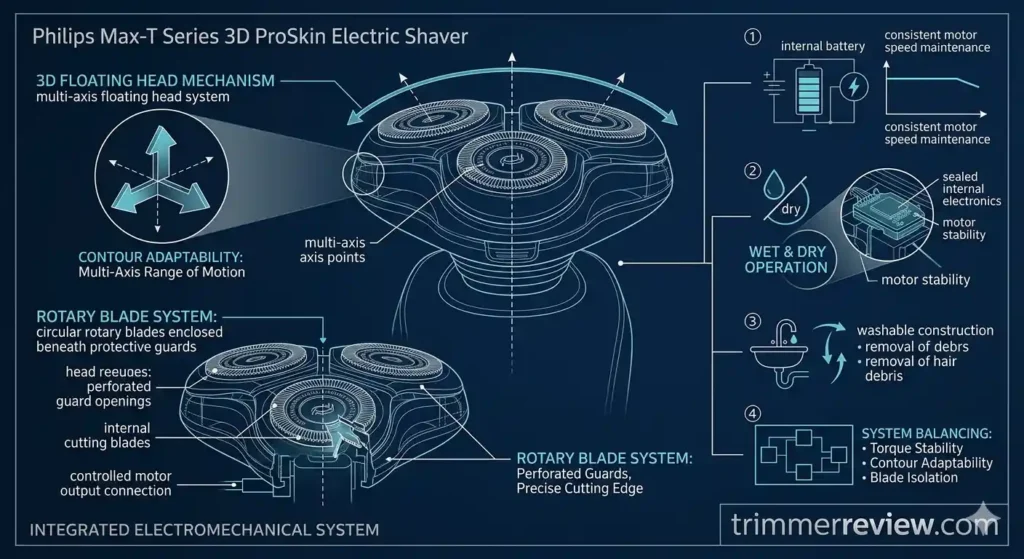
- The Philips Max-T Series 3D ProSkin Review is engineered as an integrated electromechanical system combining blade geometry, suspension mechanics, and controlled motor output. Each component operates in coordination to maintain consistent cutting efficiency while minimizing direct skin stress.
- From an engineering perspective, the architecture focuses on balancing torque stability, contour adaptability, and protective blade isolation. This design approach addresses common mechanical challenges such as uneven surface contact, friction buildup, and inconsistent hair capture during routine facial grooming.
3D Floating Head Mechanism
The shaver incorporates a multi-axis floating head system. This mechanism allows the shaving unit to adapt dynamically to facial contours.
Engineering Function:
- Maintains consistent blade-to-skin contact
- Reduces localized pressure points
- Minimizes uneven cutting across curved areas (jawline, neck)
Problem Addressed:
Fixed shaving heads often create gaps in contact, leading to repeated strokes and increased irritation. A floating system distributes contact evenly.
Rotary Blade System
The internal cutting mechanism uses circular rotary blades enclosed beneath protective guards.
Engineering Function:
- Converts rotational motion into hair-cutting action
- Allows hair entry through perforated guard openings
- Prevents direct blade-skin contact
Outcome: Reduced risk of micro-cuts and controlled trimming of surface-level hair.
Wet & Dry Operation Capability
The device supports operation in both dry conditions and with water, shaving foam, or gel.
Engineering Function:
- Sealed internal electronics prevent water ingress
- Maintains motor stability under moisture exposure
Problem Addressed: Dry shaving can increase friction, while wet shaving reduces resistance but requires electrical insulation.
Real-World Relevance: Wet operation may reduce friction on sensitive skin, while dry mode supports quick grooming without preparation.
Rechargeable Power System
The shaver operates on an internal rechargeable battery.
Engineering Function:
- Provides cordless operation
- Maintains consistent motor speed during discharge cycle
Limitation: Battery performance may degrade over time, affecting torque consistency.
Washable Construction
The shaving head and body are designed to be rinsed under water.
Engineering Function:
- Enables removal of hair debris and skin residue
- Prevents clogging of blade chambers
Hygiene Impact: Regular cleaning reduces bacterial accumulation and maintains cutting efficiency.
Technical Specification Overview
- The Philips Max-T Series 3D ProSkin Review is defined by a set of core technical parameters that govern its operational stability and grooming performance. These specifications represent the integration of mechanical design, power management, and environmental compatibility within a single handheld system.
- From an engineering standpoint, the specification framework highlights how rotary cutting mechanics, multi-directional head movement, and sealed wet–dry operation work together to maintain consistent surface-level trimming while reducing friction and mechanical resistance during use.
| Feature | Engineering Interpretation |
|---|---|
| Shaving System | Rotary blade mechanism using circular cutters to capture and trim hair across multiple growth directions |
| Head Movement | 3D floating multi-directional suspension system for adaptive contour tracking |
| Operation Mode | Wet & dry compatible design with sealed electronics for safe use with water, foam, or gel |
| Power Source | Rechargeable battery system enabling cordless and portable operation |
| Cleaning Method | Washable construction allowing rinsing under running water for debris removal |
| Usage Type | Cordless handheld device designed for routine facial grooming environments |
Performance Analysis
- The Philips Max-T Series 3D ProSkin Review operates through a combination of rotary blade motion, controlled motor output, and adaptive head movement to maintain consistent cutting behavior across varying facial contours. Performance evaluation focuses on how effectively the system manages friction, hair capture efficiency, and blade-to-skin interaction under both dry and wet operating conditions.
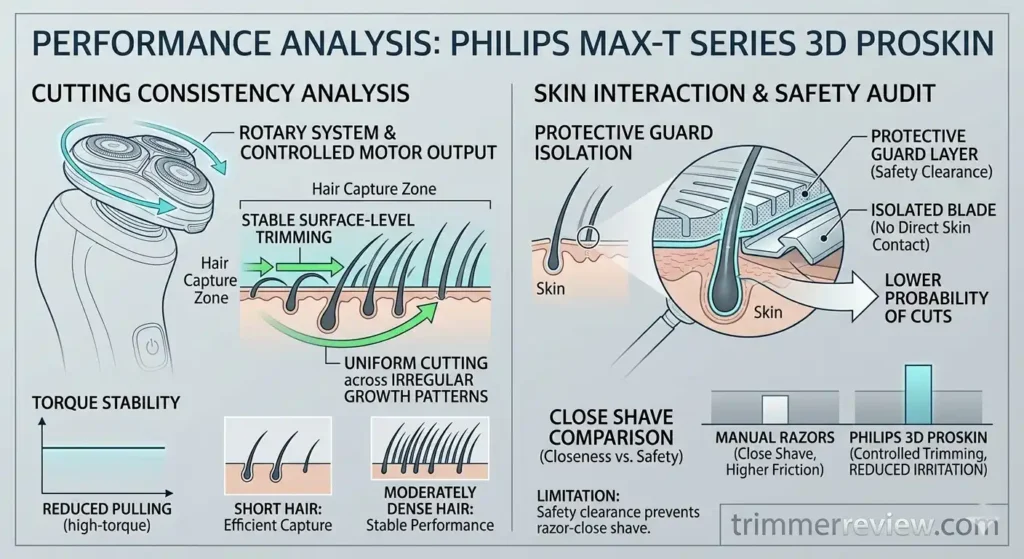
- From an engineering standpoint, the Philips Max-T Series 3D ProSkin electric shaver demonstrates stable surface-level trimming performance, with emphasis on minimizing pulling forces and maintaining uniform cutting across irregular growth patterns.
Cutting Consistency
The rotary system provides stable cutting for short to moderately dense facial hair. Performance depends on hair length and growth direction.
Observed Outcome:
- Reduced pulling compared to low-torque systems
- Consistent trimming across uneven surfaces
- In practical use, the shaver performs most consistently on 1–3 day stubble, where rotary systems can efficiently capture short, multi-directional hair without requiring repeated passes.
Skin Interaction
The protective guard layer isolates the blade from direct skin contact.
Outcome:
- Lower probability of cuts
- Reduced irritation compared to exposed blade systems
- For users with sensitive skin, this guarded rotary design typically results in less post-shave redness, especially when compared to direct-contact blade systems.
Limitation: Does not achieve as close a shave as manual razors due to safety clearance.
- Note: Skin irritation during shaving is often linked to friction and repeated strokes, as documented in dermatological studies available via the NCBI research database.
Wet vs Dry Performance
Interpretation: Wet mode is more suitable for sensitive skin environments, while dry mode prioritizes speed.
| Operating Condition | Engineering Performance Behavior |
|---|---|
| Dry Operation | Enables rapid shaving with minimal preparation, but increased skin-blade friction due to absence of lubrication |
| Wet Operation | Utilizes water or shaving agents to reduce friction, resulting in smoother glide and lower mechanical resistance on skin |
During dry shaving, slight resistance may be noticeable in denser areas such as the chin or jawline. In contrast, wet shaving significantly improves glide and reduces drag, particularly for users prone to irritation.
Use-Case Suitability
- Determining whether a specific grooming tool meets individual requirements depends on the mechanical alignment between the device’s capabilities and the user’s hair type. This Philips Max-T Series 3D ProSkin Review identifies specific scenarios where the rotary architecture excels, as well as environments where its technical limitations may become apparent.
- By analyzing the torque output and blade geometry, the following suitability benchmarks help users decide if this hardware fits their routine:
Who Should Buy
- Individuals with sensitive or irritation-prone skin
- Users requiring low-maintenance grooming tools
- Hygiene-focused users preferring washable devices
- Daily or frequent surface-level shaving routines
Who Should Avoid
- Thick or long beard trimming without pre-cutting
- Ultra-close shaving requirements
- Precision edge detailing (e.g., sharp beard lines)
Practical Usage Context
In typical real-world use, the device is most effective when operated in short, controlled strokes rather than continuous sweeping motions. Users transitioning from manual razors may require a brief adaptation period to optimize shaving technique with rotary motion.
Maintenance and Hygiene Considerations
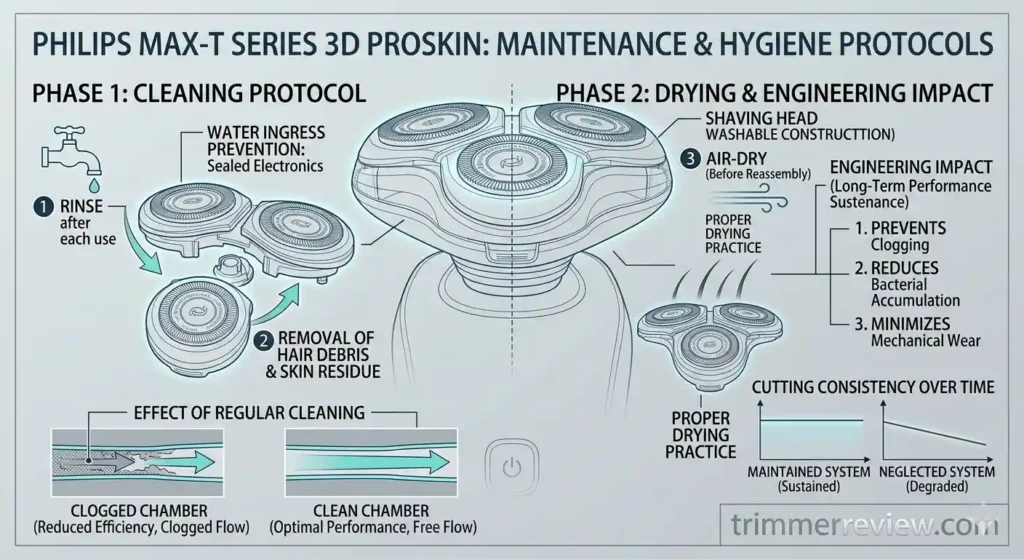
- The Philips Max-T Series 3D ProSkin Review requires consistent maintenance protocols to preserve mechanical efficiency and hygiene standards. Regular removal of hair debris and skin residue ensures that the rotary cutting system operates without obstruction, maintaining stable blade motion and airflow within the shaving chamber.
- From an engineering perspective, hygiene management directly influences long-term performance by preventing clogging, reducing bacterial accumulation, and minimizing wear on moving components. Proper cleaning and drying practices support sustained cutting consistency and reduce the risk of skin-related irritation during repeated use.
Cleaning Protocol
- Rinse shaving head after each use
- Allow components to dry before reassembly
Engineering Impact
- Prevents clogging of blade chambers
- Maintains airflow and motor efficiency
Long-Term Effect: Proper maintenance supports consistent performance and reduces mechanical wear.
Limitations and Boundaries
- Not designed for deep internal nasal or ear trimming
- Does not replace precision trimmers for detailing
- Battery degradation may affect long-term output
- Rotary systems may require multiple passes on dense hair
Safety Considerations
- Avoid use on broken or inflamed skin
- Ensure device is properly dried after wet cleaning
- Do not apply excessive pressure during operation
Biological Context: Excess pressure can increase friction and lead to skin irritation, especially in sensitive areas.
Outcome-Oriented Evaluation
- The Philips Max-T Series 3D ProSkin Electric Shaver demonstrates a mechanically stable approach to routine facial grooming. Its design focuses on controlled blade exposure, adaptive head movement, and moisture-compatible operation.
- Rather than maximizing closeness, the system prioritizes surface-level consistency, skin safety, and hygiene maintenance.
Related Expert Resources
For a more comprehensive understanding of the maintenance protocols discussed in this Philips Max-T Series 3D ProSkin Review, users should consult specialized guides on electromechanical upkeep. Proper care is essential for sustaining the performance benchmarks identified throughout this technical analysis, particularly regarding motor longevity and blade hygiene.
The following resources provide additional context for optimizing the grooming hardware:
- Improper maintenance can increase irritation risk, as explained in our guide on Why Shaver Burn Happens: Mechanical Failure and Maintenance.
- Detailed cleaning methods are covered in Deep Cleaning Philips Electric Shaver: 5 Professional Maintenance Protocols.
Final Assessment (Decision-Neutral)
This device is best understood as a maintenance-oriented electric shaving system rather than a precision or deep-cut grooming tool. Suitability depends on user preference for safety, ease of use, and moderate shaving performance rather than aggressive cutting efficiency.
Frequently Asked Questions (FAQs): Philips Max-T Series 3D ProSkin Review
The following FAQ section is designed to address technical inquiries regarding the operation and engineering of this electromechanical grooming device. These responses synthesize the core findings of this Philips Max-T Series 3D ProSkin Review to ensure users understand both the mechanical capabilities and operational boundaries of the system.
Does the 3D ProSkin system reduce skin irritation?
The 3D floating head mechanism distributes contact pressure across the skin surface, reducing localized friction. This engineering approach minimizes repeated strokes, which are a primary cause of irritation in rigid shaving systems.
How does wet shaving improve performance in this device?
Wet operation introduces a lubrication layer through water, foam, or gel. This reduces mechanical resistance between the shaving head and skin, resulting in smoother glide and lower friction during blade movement.
Is the rotary blade system suitable for all hair types?
Rotary blade systems are effective for short to moderately dense facial hair growing in multiple directions. However, longer or thicker hair may require pre-trimming, as rotary cutters are optimized for surface-level hair capture rather than bulk reduction.
Can the device achieve a close shave comparable to manual razors?
The device maintains a protective distance between the blade and skin using guard structures. This safety design reduces the likelihood of cuts but also limits the ability to achieve ultra-close shaving comparable to direct-contact manual blades.
What is the functional role of the rechargeable power system?
The rechargeable battery provides cordless operation and maintains motor consistency during use. Stable motor speed is essential for preventing uneven cutting and reducing hair pulling during high-resistance conditions.
How does regular cleaning affect performance?
Cleaning removes accumulated hair particles and skin residue from the blade chamber. This prevents obstruction in the cutting mechanism, ensuring consistent airflow, blade motion, and long-term mechanical efficiency.
Transparency & Fact-Checking
For full transparency and product information verification details, refer to the Disclaimer & Fact-Checking Policy.
