Introduction: Philips NT3650/16 Review
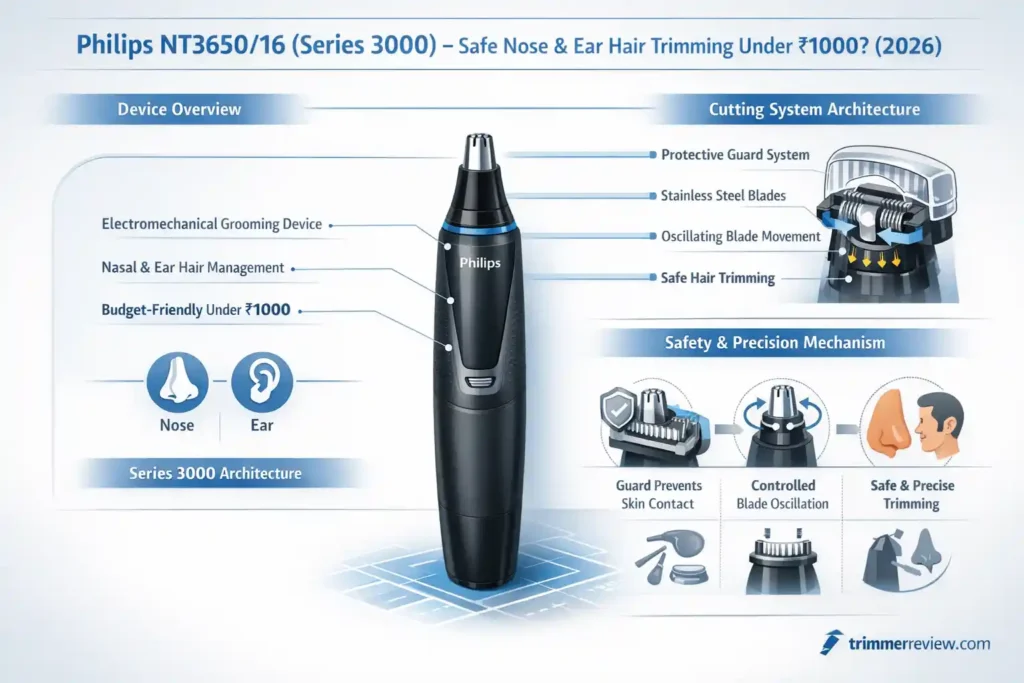
- If you’re looking for a safe and budget-friendly nose trimmer under Rs. 1000, the Philips NT3650/16 is one of the most popular choices in 2026. In this review, I’ll explain how it performs in real life, how safe it is, and whether it’s worth buying.
- You can also check the official product details on the Philips website to see its features and specifications directly from the brand.
- 👉 If you go to the office, attend meetings, or meet people regularly, this trimmer can help you stay clean and well-groomed with very little effort.
- 👉 If you want a simple, safe, and beginner-friendly nose trimmer under ₹1000, the Philips NT3650 is a very good option in 2026.
- Note: While this model is a great budget pick for everyone, we have also analyzed how it compares to other female-specific tools in our guide for the [best nose trimmer for women (2026)]
Philips NT3650 Trimmer Demo & Real Usage (2026)
Watch this quick demo to see how the Philips NT3650 works in real life. It will give you a clear idea of how safety-focused it is to use.
Video Source: TECHABHI ENGLISH
As you can see, the trimmer is simple, gentle, and beginner-friendly. It’s a good option for regular grooming without any hassle.
Quick Summary Table
If you don’t want to read the full review, here’s a quick and simple overview of the Philips NT3650/16. This summary will help you understand its key features, safety, and overall performance in just a few seconds.
| Feature | Summary |
|---|---|
| Best For | Safe and easy nose & ear hair trimming |
| Skin Safety | Very high (Protective Guard prevents cuts) |
| Cutting Comfort | Gentle trimming with minimal pulling |
| Ease of Use | Beginner-friendly and simple to operate |
| Power Type | AA battery (no charging needed) |
| Cleaning | Fully washable (easy to rinse under water) |
| Attachments | Eyebrow combs included |
| Noise Level | Low to moderate (normal motor sound) |
| Build Quality | Durable with ergonomic grip |
| Travel Friendly | Yes (lightweight + no charger needed) |
| Ideal Usage | Regular grooming (1–2 times per week) |
| Not Ideal For | Very thick or heavy hair trimming |
| Overall Focus | Safety, comfort, and simplicity |
| Rating | ⭐ 4.4 / 5 |
This quick summary gives you a clear idea of what to expect from the Philips NT3650/16. It’s mainly designed for comfortable and easy trimming, especially for regular use.
If you want more detailed insights, you can continue reading the full review below to understand its performance, design, and real-world usage.
Web Story
If you prefer short and easy-to-understand content, this story will help you quickly decide if the Philips NT3650/16 is the right nose trimmer for your needs.

Should You Buy Philips NT3650/16?
- Regular nose & ear hair trimming
- Beginners who want a safe and easy trimmer
- People looking for a budget-friendly option under ₹1000
- Users who prefer simple, no-maintenance grooming
- Travel-friendly and quick use
- Gentle trimming with minimal pulling
- Beginner-friendly and simple to use
- No charging needed (AA battery)
- Very safe for sensitive areas (protective guard)
- Not ideal for very thick or dense hair
- No advanced speed or precision control
- Basic performance compared to premium trimmers
- If you have very thick or dense hair
- If you want very precise or salon-level trimming
- If you prefer rechargeable trimmers with more features
👉 In these cases, you may need a more powerful or premium trimmer.
💡 You can consider options like Panasonic ER-GN30 for better precision or higher-end rechargeable trimmers.
👉 Buy it if you want a safe, simple, and budget-friendly trimmer for regular grooming.
👉 Skip it if you need high precision or want to trim thick hair.
Verdict: A reliable and safe trimmer for everyday use—perfect for beginners but not for heavy-duty trimming.
Real Performance & Usage Experience
Trimming Experience
The Philips NT3650/16 gives a smooth and comfortable trimming experience in real use. It has a protective guard that keeps the blades away from your skin, so there is very little risk of cuts or irritation.
👉 For normal nose hair:
Trimming feels smooth
Very little pulling
Usually done in 1–2 passes
👉 For thick hair:
May take a bit more time
You might need a few extra passes
Overall, it works well for regular grooming and gives reliable results.
Comfort & Safety
This trimmer is very comfortable and safe, even for beginners.
The protective guard keeps your skin safe
You don’t feel discomfort while using it inside the nose
Suitable for sensitive areas
👉 If you are using a nose trimmer for the first time, this is a comfortable choice.
Speed & Efficiency
This trimmer works at a fixed speed, so there is no speed control.
Speed is good enough for normal hair
Great for quick touch-ups
May feel slightly slow on thick or dense hair
👉 The main focus is not speed, but safe and controlled trimming.
Design & Handling
Grip & Comfort
The Philips NT3650/16 is easy to hold and feels comfortable in the hand.
It has a non-slip grip, so it doesn’t slip even if your hands are wet.
Lightweight and easy to handle
Good grip for better control
Comfortable to use for a few minutes
👉 Overall, it feels stable and safe while trimming.
Ease of Use
This trimmer is very simple to use, even for beginners.
Just insert the battery and turn it on
No complex settings or buttons
Easy to move inside the nose and ears
👉 You don’t need any special skill — anyone can use it easily.
Limitations & Things to Consider
Before buying the Philips NT3650/16, here are a few things you should keep in mind:
It runs on an AA battery, so you will need to replace the battery from time to time
It works at a fixed speed, so there is no option to adjust power
It may feel a bit slow if you have very thick or dense hair
It is made for simple grooming, not for very precise or heavy-duty trimming
👉 Overall, this trimmer is best for basic and regular use, but not for advanced or high-performance needs.
NT3650 vs Mi S100 vs Panasonic ER-GN30: Detailed Comparison Table
Choosing the right nose trimmer can be confusing, especially when many options look similar. To make things easier, here’s a simple comparison of the Philips NT3650, Mi S100, and Panasonic ER-GN30.
This table will help you quickly understand the key differences in safety, performance, and overall usability so you can pick the one that suits your needs.
| Feature | Philips NT3650 Nose Trimmer ⭐ Recommended | Mi Nose Trimmer S100 | Panasonic ER-GN30 |
|---|---|---|---|
| Cutting System | Protective Guard + dual-sided blades | Rotary blade system | Dual-edge vortex blade system |
| Skin Safety | High (guard prevents direct contact) | Moderate (rotary head, less shielding) | High (curved blades + inner cone) |
| Trimming Comfort | Gentle, minimal pulling | Smooth initially, may tug on dense hair | Very smooth & precise |
| Cleaning | Fully washable | Fully washable | Fully washable (Vortex cleaning system) |
| Power Source | AA battery | AA battery | AA battery |
| Battery Life | Good (depends on usage) | Good | Very good |
| Wet & Dry Use | Yes (showerproof) | Yes | Yes |
| Noise Level | Low to moderate | Low | Moderate |
| Build Quality | Solid plastic, ergonomic grip | Lightweight, minimal design | Premium, sturdy build |
| Ease of Use | Very easy (beginner-friendly) | Easy but less precise control | Easy with better precision |
| Precision | Good for visible hair | Basic trimming | Best precision among three |
| Attachments | Eyebrow combs included | Usually no attachments | Usually no attachments |
| Travel Friendly | Yes (lightweight + pouch) | Yes (compact) | Yes |
| Price Range (India) | Budget (₹800–₹1200) | Budget (₹700–₹1000) | Mid-range (₹1300–₹1800) |
| Best For | Safe & simple grooming | Budget users | Performance & precision users |
As you can see, each trimmer has its own strengths. The Philips NT3650 focuses on safety and ease of use, the Mi S100 is a simple budget option, and the Panasonic ER-GN30 offers better precision and performance.
Think about what matters most to you—safety, price, or performance—and choose accordingly. For most users, a safe and easy-to-use trimmer is usually the best choice for regular grooming.
👉 Go for Philips NT3650 if you want maximum safety and easy use (best for beginners)
👉 Choose Mi S100 if you want the cheapest basic option
👉 Pick Panasonic ER-GN30 if you want better precision and smoother performance
👉 If you’re confused, just go with Philips NT3650 for safety — it’s the safest option for most users.
Maintenance, Hygiene & Safe Grooming
Maintenance & Hygiene
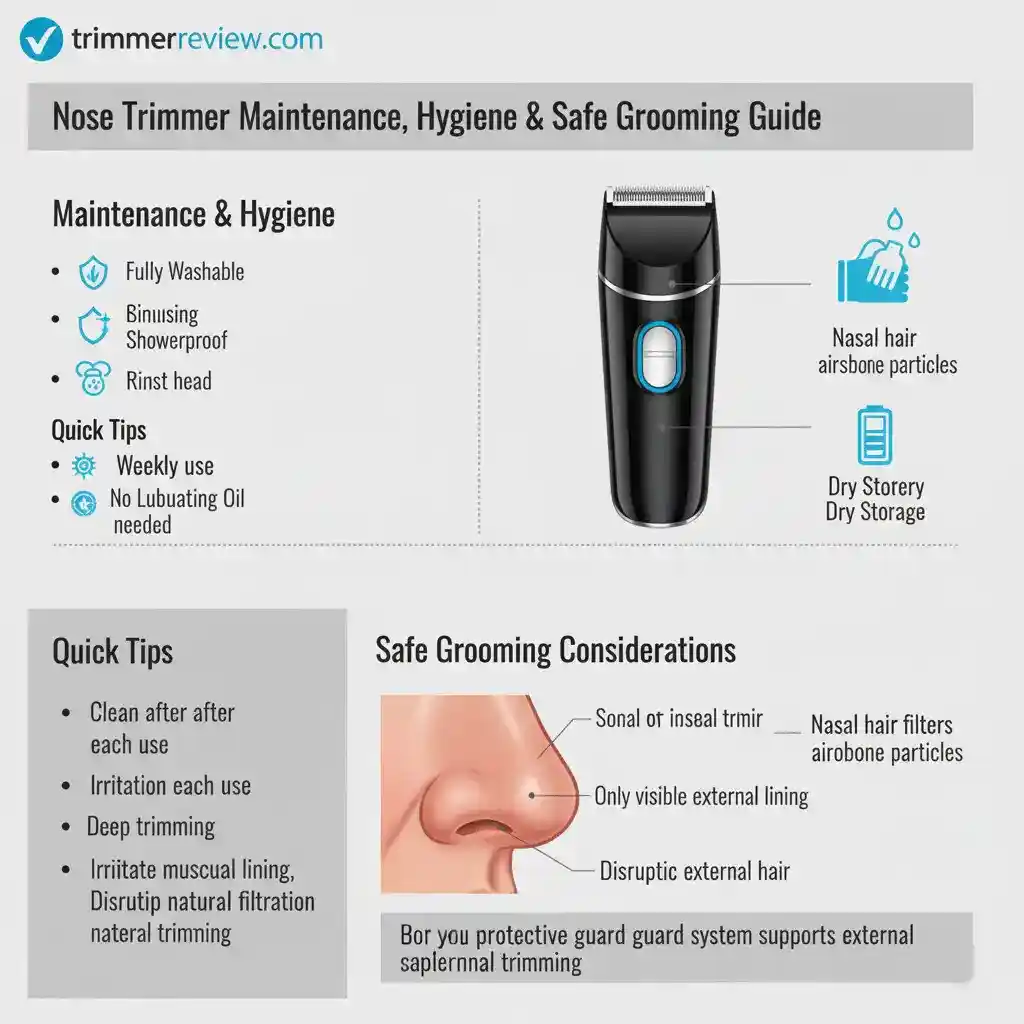
You can easily wash it under running water and is designated as showerproof. Post-grooming maintenance involves rinsing the head under running water. Because the stainless steel blades are engineered for maintenance-free use, the application of lubricating oil is unnecessary.
Quick Tips
- Always clean the trimmer after use.
- Use weekly for optimal hygiene.
- Store in a dry place to preserve blade longevity.
- Replace AA battery as needed to maintain consistent performance.
- Avoid inserting the trimmer too deep to protect mucosal lining.
Safe Grooming Consideration
Nasal hair actually helps filter dust and other particles from the air you breathe.
Because of this:
- Only trim the hair you can see on the outside.
- Avoid trimming deep inside, as it can irritate the delicate lining and interfere with its natural filtering.
The trimmer’s protective guard is designed to make external trimming safe while keeping the blades from touching your skin directly.
Power System & Ownership Considerations
Battery vs Rechargeable
- Battery-powered (Philips NT3650/16): Ready to use right away, no worries about battery aging, and easy to take on trips.
- Rechargeable Alternatives: Have built-in batteries that save money on replacements, but you need to wait for charging and the battery may lose capacity over time.
Long-Term Ownership Logic
With this trimmer, the main cost is just replacing the AA battery. Unlike rechargeable trimmers, which can lose power as their internal batteries age, this model stays reliable as long as you keep the battery working. To keep the blades lasting longer, just make sure the cutting head stays clean and avoid using it on rough or abrasive materials.
Pros & Cons
| Pros | Cons |
|---|---|
| Protective Guard prevents irritation | Recurring battery replacement costs |
| Maintenance-free blade design | Fixed speed operation |
| Fully washable for hygiene | External battery dependent |
User Reviews
- Smooth trimming without pain or irritation
- Very easy to use, even for beginners
- Protective guard makes it safe for sensitive areas
- Good for regular nose hair trimming
- Compact and travel-friendly design
- Value for money for basic grooming
- Takes more time on thick or dense hair
- Not very precise compared to premium trimmers
- May not clean ear hair perfectly
- Some users noticed slight heating
- Performance feels basic for the brand expectation
Recommended Usage Frequency
- For regular hygiene, trimming your nose and ear hair with the Philips NT3650/16 once every 1–2 weeks is enough.
- You don’t need to trim too often, since nasal hair helps filter dust and particles
- Just keeping up with routine grooming is usually sufficient.
Related Guides & Expert Resources
- Philips NT3650/16 vs Philips Norelco NT3600 – Technical breakdown of regional variations.
- Philips Nose Trimmer Series 3000 vs 5000 – Performance and feature-set comparison.
- How to Use a Nose Trimmer (Step-by-Step) – Operational guide for optimal results.
Note: Many users often wonder if the international variants offer better hardware. We have cleared this confusion in our [Philips NT3650/16 vs. Philips Norelco NT3600 comparison], where we dissect the engineering differences between the Indian and North American models.
Frequently Asked Questions (FAQs)
Is the Philips NT3650/16 better than the NT3600?
Both trimmers perform the same. The main difference is the market: the NT3650/16 is sold in India and global markets, while the NT3600 is for North America.
Can women use this nose and ear trimmer?
Yes! Thanks to the Protective Guard System, anyone can safely trim nose and ear hair without risk of cuts.
Does the Philips NT3650/16 need oiling?
No. The self-sharpening blades work perfectly without any oil or lubrication.
Is it loud?
It produces a standard motor hum, typical for high-torque trimmers, but it’s not distracting.
Is the Philips NT3650/16 good for travel?
Yes. It runs on a single AA battery and comes with a protective cap, making it lightweight, portable, and easy to carry without chargers.
Transparency & Fact-Checking
For full transparency and product information verification details, refer to the Disclaimer & Fact-Checking Policy.
