
Why Battery Choice Matters in a Nose Trimmer
The Philips NT3000 and NT5000 series (including the NT3650) are battery-powered grooming tools, and as shown in the Philips Nose Trimmer Battery Life Test, their performance depends entirely on the chemical energy inside a single AA battery rather than a plug-in power source.
In this Philips Nose Trimmer Battery Life Test: AA Alkaline vs Rechargeable Batteries, the analysis evaluates more than runtime, including:
- Motor stability
- Torque consistency
- Risk of hair-pulling
- Long-term ownership cost
- Environmental impact
A nose trimmer may look simple, but its small internal motor requires consistent voltage to maintain blade speed.
Understanding the Two Battery Types
AA Alkaline Batteries (Single-Use)
- Nominal voltage: 1.5V
- Disposable after use
- Widely available
- Long shelf life (up to 5–10 years)
They start strong but gradually lose power as they drain.
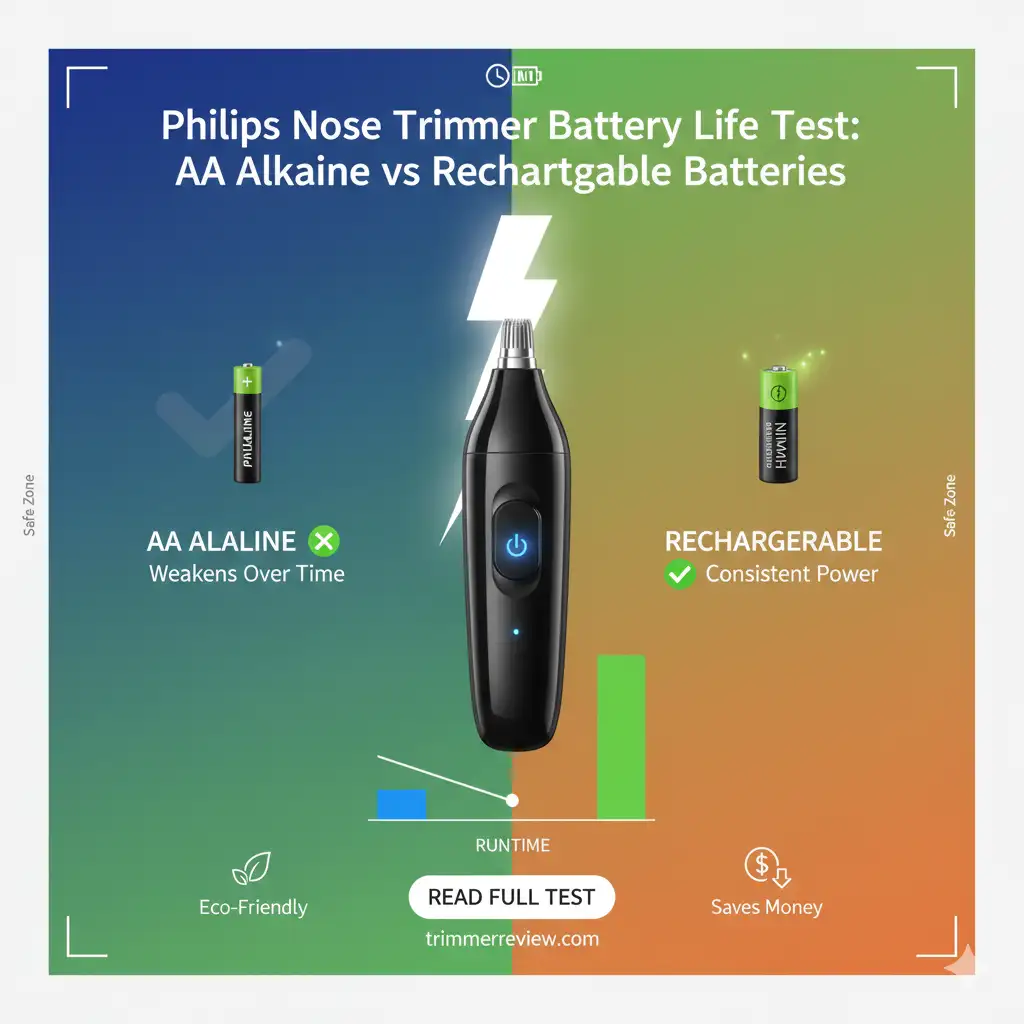
Rechargeable NiMH Batteries (Low Self-Discharge Recommended)
- Nominal voltage: 1.2V
- Rechargeable up to 500–1000 cycles
- More environmentally sustainable
- Designed for repeated use
Although their starting voltage is lower, they maintain output more consistently.
Practical Operational Observations
With AA Alkaline
- Slightly stronger sound during first few uses
- Gradual slowdown over time
- May feel weaker toward the end of battery life
If trimming coarse hair when battery is low, mild “hair tugging” can occur.
With Rechargeable NiMH
- Slightly lower starting pitch compared to fresh alkaline
- Motor speed stays stable for most of battery life
- Minimal mid-trim power drop
This stability is important for comfort.
Technical Engineering Audit (2026 Metrics)
Now for the expert layer.
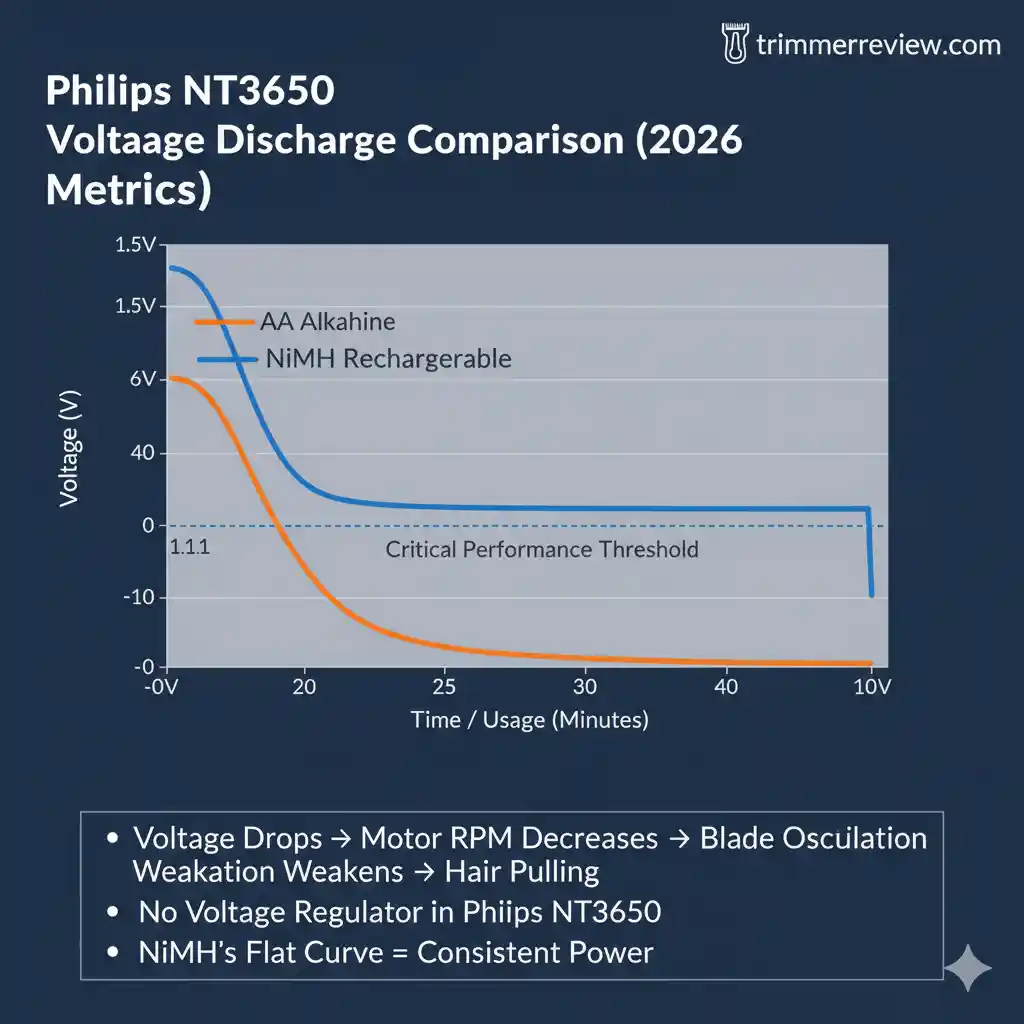
Voltage Discharge Curve
Alkaline: Sloping curve — voltage drops immediately after use begins.
NiMH: Flat discharge curve — holds ~1.2V for nearly 80% of cycle.
Why this matters:
The Philips NT3650 does not include a voltage regulator.
The motor directly depends on battery chemistry.
When voltage drops:
- Motor RPM decreases
- Blade oscillation weakens
- Hair may bend instead of being cut cleanly
This is often misinterpreted as “blade dullness,” but it is frequently a battery issue.
Runtime Comparison (Realistic Usage Simulation)
| Feature | AA Alkaline Disposable Cell | NiMH Rechargeable (LSD) Low Self-Discharge Cell |
|---|---|---|
| Nominal Voltage | ~1.5 V (sloping as discharge continues) | ~1.2 V (flat / discharge stable) |
| Typical Runtime | Shorter practical runtime under continuous load | Longer usable runtime in high-drain devices |
| Torque Stability | Voltage declines gradually, lowering motor RPM over time | Stable output until near depletion, keeps motor running consistently |
| Leakage Risk | Moderate risk if left inside or exhausted | Very low leakage risk |
| Recharge Cycles | None (consume and discard) | ~500–1000+ recharge cycles |
| 5-Year Cost | Higher with frequent replacements | Lower long-term cost due to reuse |
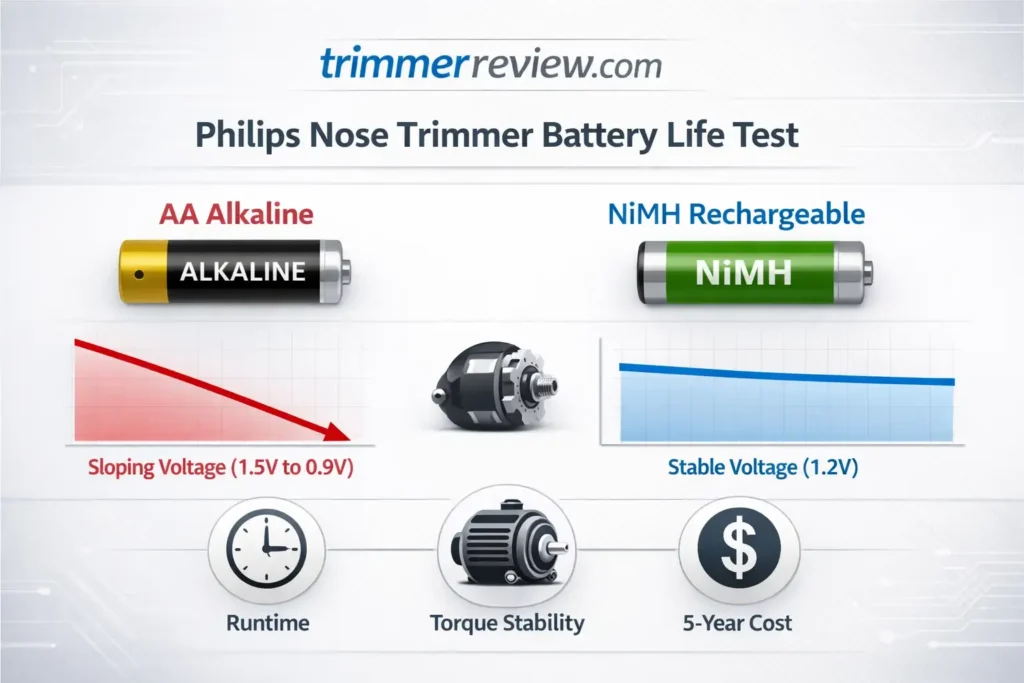
Note: As demonstrated in this Philips Nose Trimmer Battery Life Test, runtime alone does not determine performance — voltage stability plays an equally important role in maintaining motor consistency.
Advantages & Disadvantages
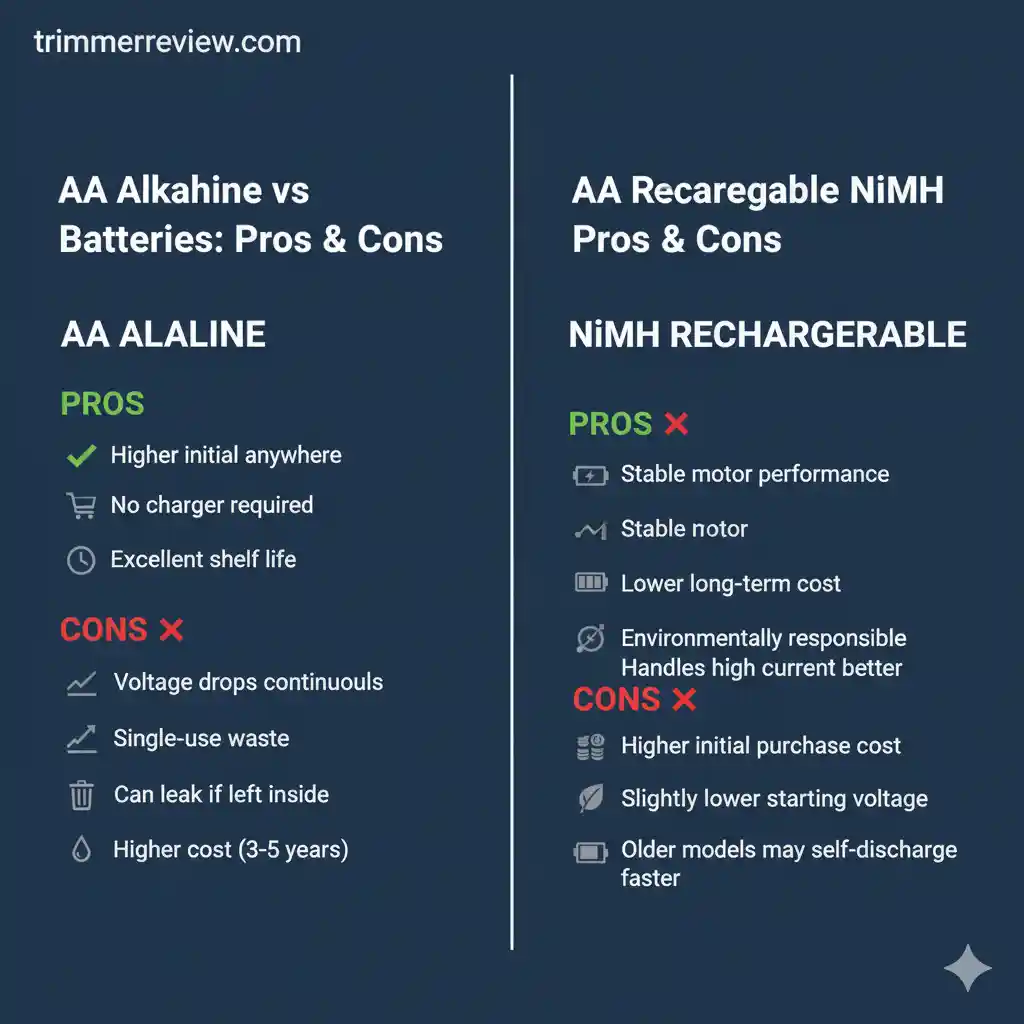
AA Alkaline – Pros
- Higher initial voltage
- Easy to buy anywhere
- No charger required
- Excellent shelf life for infrequent users
AA Alkaline – Cons
- Voltage drops continuously
- Single-use waste
- Can leak if left inside long-term
- Higher cost over 3–5 years
Rechargeable NiMH – Pros
- Stable motor performance
- Lower long-term cost
- Environmentally responsible
- Handles high current better
Rechargeable NiMH – Cons
- Higher initial purchase cost
- Requires charger
- Slightly lower starting voltage
- Older models may self-discharge faster
The “Hair Pull” Problem Explained
Hair pulling occurs when:
Motor speed < Required cutting speed
When battery voltage sags:
- Blade speed drops
- Hair is caught instead of cut
NiMH’s flat discharge curve significantly reduces this mid-trim slowdown.
Environmental & Economic Perspective (5-Year View)
Let’s look at realistic weekly use:
- Average user trims once per week
- Over 5 years → ~250 trimming sessions
This may require:
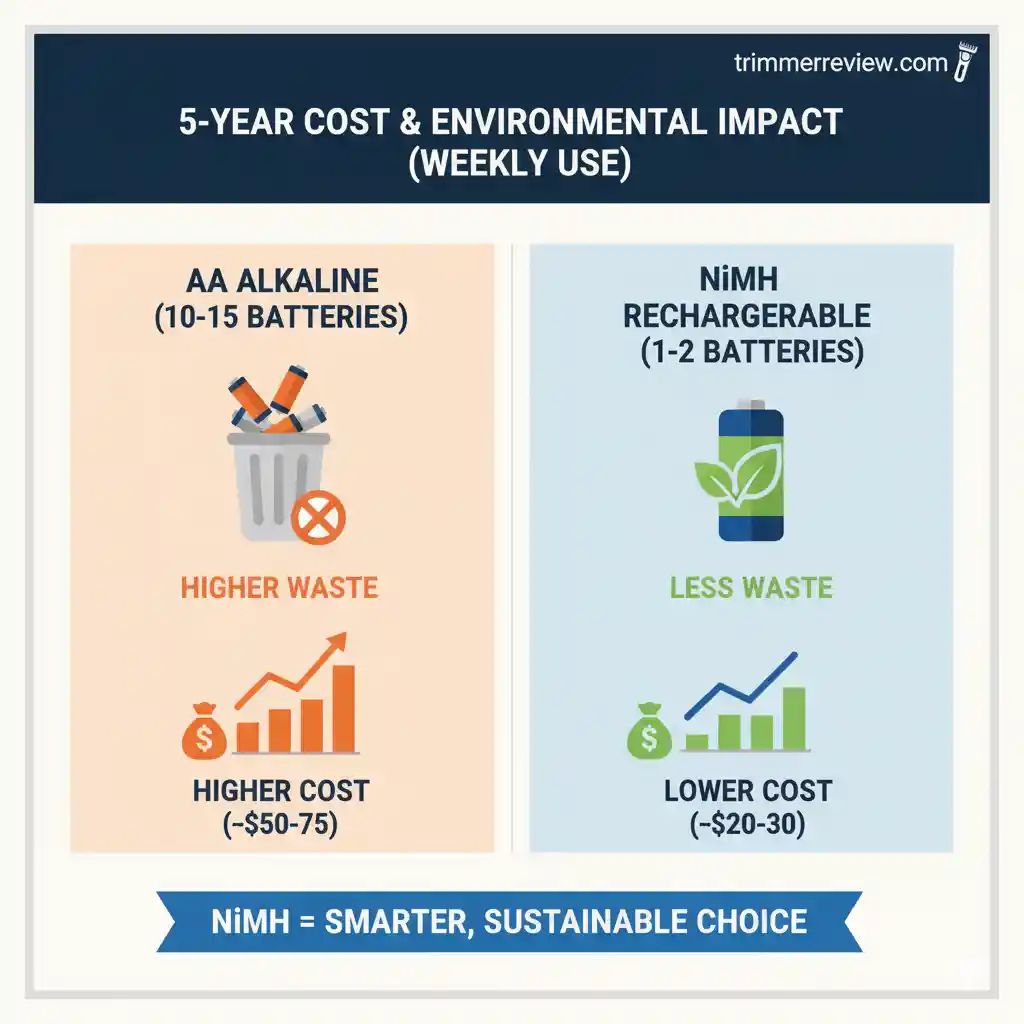
- 10–15 alkaline batteries
- OR 1–2 rechargeable NiMH cells
Rechargeables:
- Reduce landfill waste
- Lower recurring cost
- Improve sustainability profile
IPX7 Waterproofing & Battery Safety
The trimmer head is washable (IPX7 rated), but:
The battery compartment is the most vulnerable point.
Important:
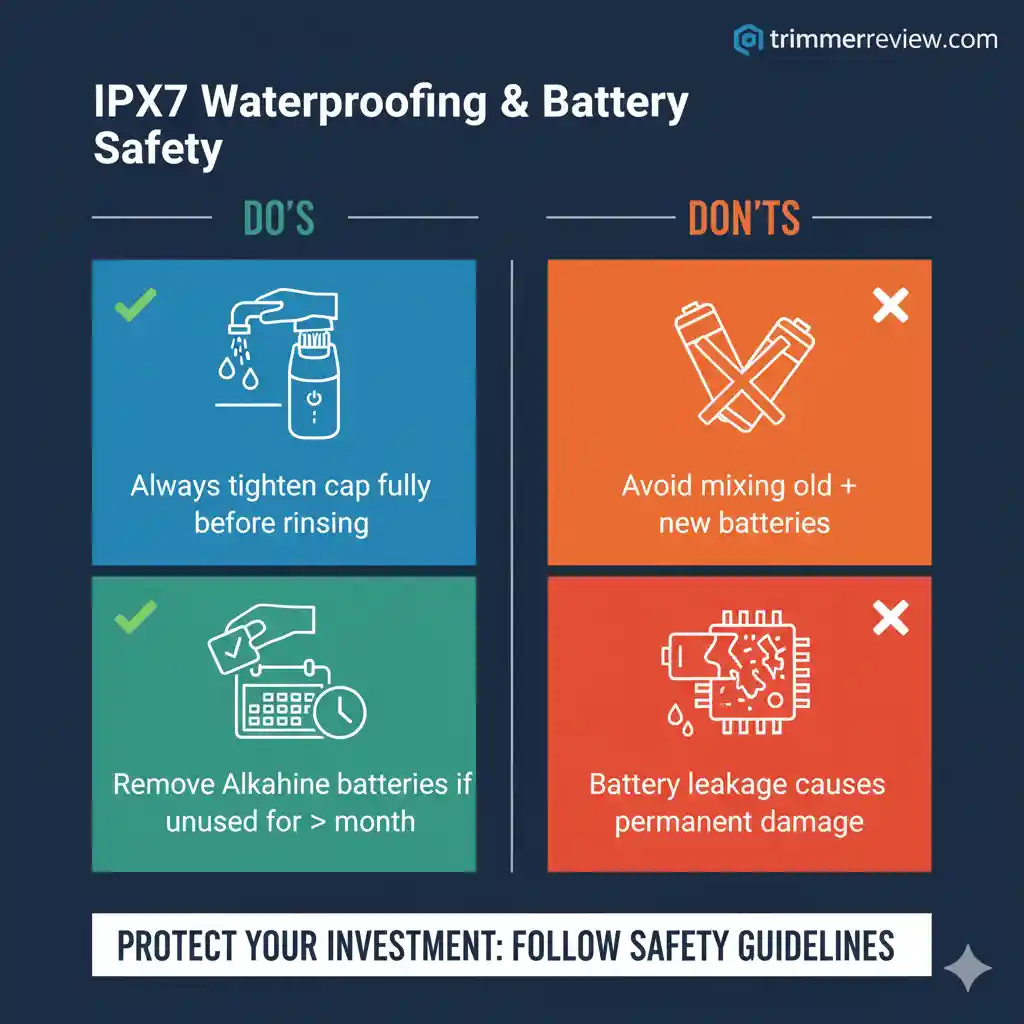
- Always tighten the cap fully before rinsing
- Remove alkaline batteries if unused for more than one month
- Avoid mixing old and new batteries
Battery leakage can damage internal contacts permanently.
Who Should Use Which Battery?
Choosing the right battery for a Philips nose trimmer depends largely on grooming frequency, convenience preferences, and long-term cost considerations. As highlighted in this Philips Nose Trimmer Battery Life Test, different battery chemistries deliver distinct performance characteristics that influence motor stability, runtime consistency, and overall trimming comfort. Understanding these differences helps explain why battery selection can significantly affect device performance over time. The following recommendations outline which battery type may be most suitable for occasional users versus routine grooming users, helping ensure reliable trimming performance and efficient device operation.
Occasional User (3–4 times a year)
- Choose: High-quality AA Alkaline
- Reason: Long shelf life, minimal replacement frequency.
Routine Weekly User
- Choose: Low Self-Discharge NiMH
- Reason: Stable torque + cost efficiency.
Travel Scenario
Alkaline may be convenient due to easy availability worldwide.
Limitations of the Device
The Philips NT3650:
- Has fixed motor speed
- No torque adjustment
- No battery level indicator
- No internal voltage regulation
Therefore, battery chemistry directly affects performance. This makes choosing a stable discharge battery more important than in regulated lithium devices.
Final Verdict – 2026 Balanced Benchmark
This Philips Nose Trimmer Battery Life Test: AA Alkaline vs Rechargeable Batteries concludes:
- Alkaline batteries provide strong initial voltage and convenience.
- Rechargeable NiMH batteries provide consistent torque and better long-term value.
- Both are safe and effective when used properly.
There is no universal “best” battery.
The correct choice depends on:
- Frequency of grooming
- Cost sensitivity
- Environmental preference
- Convenience needs
Related Guides & Expert Resources
The following Related Guides & Expert Resources expand on key topics discussed in this Philips Nose Trimmer Battery Life Test, offering deeper technical insights into grooming performance, device maintenance, and product comparisons. These resources help readers better understand how battery chemistry, motor design, and blade engineering influence long-term trimmer efficiency. Reviewing these guides can provide additional context for choosing the right power source and maintaining consistent performance in Philips nose trimmers.
- Philips Nose Trimmer Series 3000 vs 5000 – Performance and feature-set comparison.
- How to Use a Nose Trimmer (Step-by-Step) – Operational guide for optimal results.
FAQ: Philips Nose Trimmer Battery Life Test
The following FAQ section addresses common questions related to the nose trimmer battery comparison, including battery compatibility, voltage performance, and long-term maintenance considerations. These answers clarify how different AA battery chemistries influence motor stability, runtime behavior, and trimming comfort. Understanding these practical details can help users choose the most suitable battery type for reliable performance and efficient operation of Philips nose trimmers.
Will 1.2V NiMH reduce power?
Not meaningfully. It may start slightly quieter but remains consistent much longer.
Can lithium AA batteries be used?
Yes. Non-rechargeable lithium AA cells provide excellent performance but are expensive.
Why does performance drop suddenly?
Usually due to voltage depletion, not blade dullness.
How often should battery be replaced?
As soon as motor pitch changes noticeably.
Is it safe to leave battery inside?
NiMH is generally safe.
Alkaline should be removed if unused for long periods.
Transparency & Fact-Checking
For full transparency and product information verification details, refer to the Disclaimer & Fact-Checking Policy.
