
Technical FAQ: Trimmer Maintenance & Troubleshooting
Last Updated: February 21, 2026
This section addresses common technical inquiries regarding grooming technology, device maintenance, and hardware care. This engineering FAQ repository provides data-driven insights.
What is the scope of TrimmerReview.com?
TrimmerReview.com serves as an independent technical resource focused on the mechanical assembly, maintenance, and performance optimization of grooming electronics.
How are technical assessments conducted?
Assessments are derived from official manufacturer specifications, engineering documentation, and established industry maintenance protocols.
Does this platform sell grooming equipment?
No. TrimmerReview.com does not engage in the sale of hardware or products.
How should device maintenance issues be handled?
Users are encouraged to follow the official product manual provided by the manufacturer. Maintenance procedures outlined on this platform are intended to complement official documentation, not replace it.
What if the technical information is outdated?
Grooming technology evolves rapidly. If a technical discrepancy is identified, please contact the editorial team for verification.
How can technical assistance be requested?
For specific troubleshooting inquiries, contact the team at: saidrakhan@gmail.com. Please include the product model for efficient FAQ processing.
Is personal data collected on this platform?
TrimmerReview.com prioritizes visitor privacy. Personal data is not collected unless voluntarily shared via email. Please refer to the Privacy Policy for details.
Are these repair guides professional advice?
The guides provided are for informational and educational purposes. Any maintenance or repair work performed on grooming devices is conducted at the user’s own risk. For complex hardware malfunctions, professional servicing is recommended.
Advanced Engineering FAQ: Technical Analysis
Refer to this FAQ for standardized maintenance protocols regarding high-performance grooming hardware.
Conclusion
Utilizing hydrophobic oil coatings is a mandatory maintenance protocol to neutralize environmental moisture and ensure the cutting edge remains sharp for 2026-standard grooming cycles.
Adherence to these FAQ guidelines ensures hardware longevity and operational efficiency. Note: For further technical assistance, the comprehensive Maintenance Guides are available to optimize device performance.
How does blade-to-skin friction ratio impact thermal degradation?
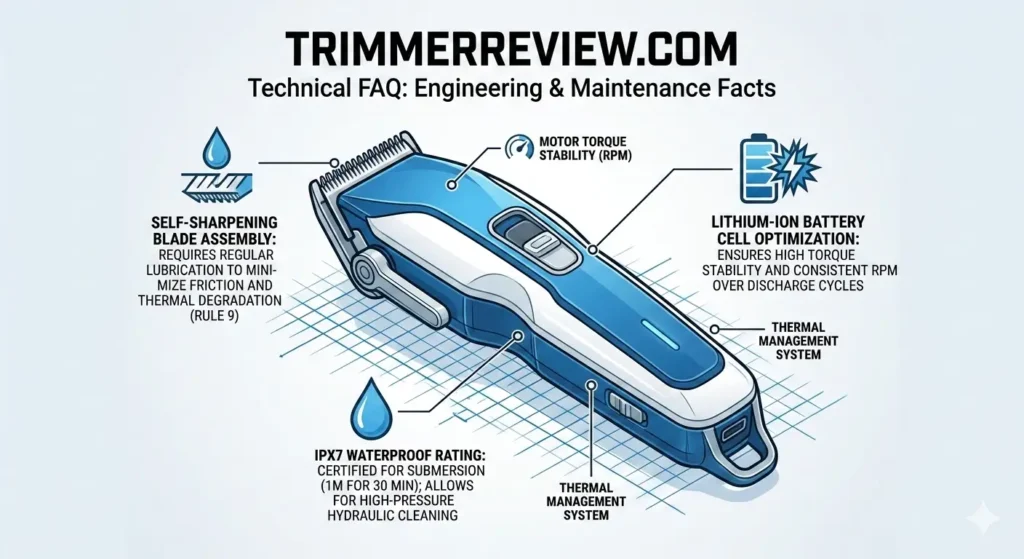
Blade-to-skin friction is a critical metric in grooming engineering. High friction levels generate excessive heat, leading to the thermal expansion of the steel blades. This expansion causes RPM instability and premature motor wear. Maintaining a low friction ratio through proper lubrication ensures consistent cutting performance.
What is the significance of IPX7 certification in maintenance protocols?
IPX7 certification signifies that the hardware can withstand immersion in water up to 1 meter for 30 minutes. From a maintenance perspective, this allows for high-pressure hydraulic cleaning of the internal cutting chamber without compromising the electronic circuitry or motor housing.
How do Lithium-ion discharge cycles affect motor torque over time?
As Lithium-ion batteries undergo multiple discharge cycles, internal resistance increases, leading to potential voltage drops during high-load operations. This reduction in voltage directly impacts motor torque, often resulting in “hair tugging” as the RPM fluctuates.
How does atmospheric humidity impact blade oxidation in precision trimmers?
Atmospheric humidity introduces moisture molecules that catalyze the oxidation process in high-carbon steel alloys. Without a protective layer of hydrophobic lubricant, oxygen reacts with the metallic surface, causing micro-corrosion. This structural degradation increases surface roughness, which significantly heightens the friction coefficient.
How does motor torque stability correlate with harmonic vibration levels?
Technical Analysis: Motor torque stability is directly influenced by the dampening of harmonic vibrations within the trimmer housing. High-frequency oscillations can lead to mechanical resonance, which creates energy loss and reduces the effective torque delivered to the blade assembly. For high-performance grooming hardware, maintaining precise axial alignment is mandatory to minimize these parasitic vibrations. By optimizing the internal chassis and utilizing vibration-absorbing mounting systems, trimmers can maintain consistent RPM even under high load conditions, ensuring a smoother cutting experience and extending the operational lifespan of the drive train.